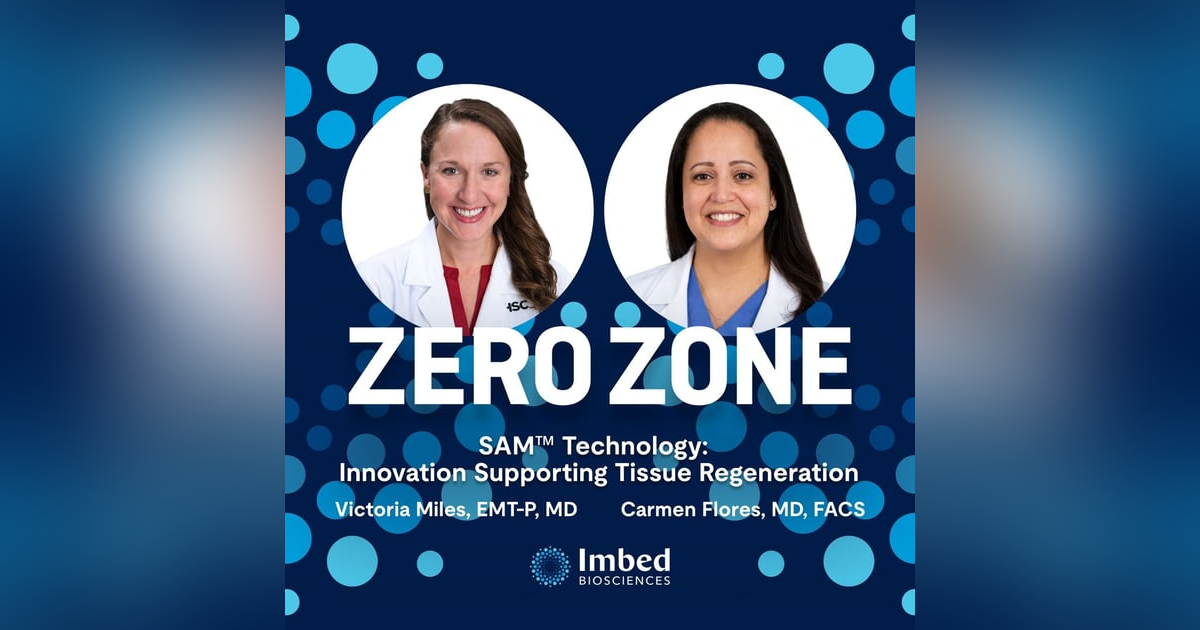
SAM™ Technology: Innovation Supporting Tissue Regeneration


Effective burn and wound care encompasses both pain control and infection risk management to ensure optimal outcomes as well as a superior patient experience.
Burn surgeon Dr. Victoria Miles and trauma surgeon Dr. Carmen Flores join host Brad Wiggins to discuss recent clinical experiences using emerging tissue regeneration technologies in complex burn and wound care, including Imbed Biosciences’ Synthetic Antimicrobial Matrix (SAM) Pelashield™ PainGuard™, containing both antimicrobial silver and lidocaine HCl for simultaneous wound protection and pain-relief.
Through cases involving donor sites, chronic wounds, and limb salvage, they describe how incorporating these products into the care regime for these types of wounds can help create a more favorable healing environment.
Hear their approaches to managing donor site pain, controlling microbial burden in high-risk and colonized wounds, and supporting earlier mobility and graft integration for their patients. The surgeons note reductions in opioid requirements and the downstream impact that improved pain control can have on rehabilitation and recovery.
GUESTS
Victoria Miles, EMT-P, MD
Dr. Victoria Miles is an assistant professor of burn surgery at LSU and a burn surgeon with advanced training from UT Southwestern’s Parkland Hospital, where she earned the Top Knife Award for technical excellence. She is an active leader in national and international burn organizations and has authored more than 40 publications focused on burn care, resuscitation, and limb salvage.
Connect with Dr. Victoria Miles on LinkedIn
Carmen Flores, MD, FACS
Dr. Carmen Flores is an acute care, trauma, and burn surgeon practicing at a Level I trauma center in Las Vegas, where she treats complex burn injuries, chronic wounds, and limb salvage cases. Her work focuses on managing high-risk, chronically infected wounds and improving patient outcomes through advanced surgical and wound care strategies, particularly in medically underserved settings.
About Brad Wiggins, BSN, RN, CBRN
Brad Wiggins, BSN, RN, CBRN served patients for over three decades as a burn unit nurse before transitioning to clinical education. Today, as Vice President of Clinical Affairs at Imbed Biosciences, he's dedicated to advancing standards of care to help burn and wound care clinicians achieve better outcomes for patients.
Connect with Brad Wiggins on LinkedIn
About Zero ZoneZero Zone brings together the people at the forefront of burn and wound care for conversations about the future of tissue regeneration and SAM™ (Synthetic Antimicrobial Technology).
With Brad Wiggins, longtime burn unit nurse turned clinical educator, surgeons, trauma specialists, and wound care teams share how they're reducing complications and improving patient outcomes.
Hear discussion and analyses of real cases where SAM™ Technology made the difference—what worked, what didn't, and how protocols are evolving to reduce opioids, get patients moving sooner, and how the burn care community is on a collective mission to achieve zero complications – together.
Learn more about Imbed Biosciences
Follow Imbed on Instagram @imbedbio and on LinkedIn
Zero Zone is a production of The Axis: theaxis.io
Brad Wiggins (00:00):
Thank you so much for joining us on The Zero Zone. Before you get started in listening to our new podcast, I'd like to give you a little bit of a background. My name's Brad Wiggins. I spent a long career at the University of Utah Burn Center, very focused on delivery of care with adult and pediatrics across all different care continuums, and it really became a lifelong passion of mine and became something that I felt was almost a calling. And I'm excited to be able to share those possibilities through this podcast. One of my proudest moments in burn care happened not at the University of Utah Hospital, and I'm hoping you'll bear with me for a second while I share that with you to think about how we want to direct this podcast and where we want to take it in the future. The year was 2012.
(00:48):
I was asked to go to China to visit a burn center there to help them learn how to deliver better burn care. It was a burn center that was in the Tibetan Plateau area, so probably a six-hour flight further west from Beijing in the small 10 million people town of Xining, China. And we met a lovely group of medical professionals who were really dedicated to wanting to help people get better from their burn injuries. When you walked into the hospital, you walked in on the ground level to dirt floors. Now, there was ceramic there, but it was covered in dirt. No one was cleaning the floors, nothing like that. But as you went up a level, I found this critical care ICU, intensive care unit. It was full of all the exact same technology that I had at my academic medical center at the University of Utah.
(01:45):
All the same beds, all the same ventilators, all the same gear, all the same tools for those medical providers to take care of all those patients. But this wasn't where the burn patients were. The burn patients were 20 floors above us, and they were in the top level of this hospital. Now, in the United States, you think, "Oh, you're at the top level, you're in the penthouse, you're in the suite." What you come to find out very quickly is that if you're at the top level of the hospital, that's actually more difficult to get to because the elevators are completely stuffed with people, more so than you've ever felt in your life anytime you go up an elevator. So when you get to the burn center, you find that patients were still roomed together. You found that there was very low quality in hand hygiene.
(02:28):
You found that there was very low quality of knowledge around basic wound care principles. Things like teaching them how to wash a burn wound is something that they weren't doing. They have access to lots of hot water for their tea, but they weren't using any hot water with soap to actually clean patient's wounds. When we think about the zero zone, one of the moments that defined my whole burn medical career was the fact that we were asked to consult on a little three-year-old boy that had a 30% total body surface area burn. Had been in the hospital for three weeks, and they said to us, "He has pneumonia and we think he's going to die, and we want you to take a look at him to see what we can do. Would like your advice." Well, we pulled up his x-ray and they had taken an x-ray, they had technology, and we looked at his x-ray and yeah, sure enough, he had pneumonia.
(03:24):
We went to see him at the bedside and we came to find a little boy whose wounds were mostly healed, progressing really well actually, but he had pneumonia and he was stiff as aboard. We said to the providers, "Do you walk him?" They're like, "Oh no, you can't walk a burn patient." "Well, no, actually you can. We're going to walk him. Oh no, we don't walk our patients. He's been in bed for three weeks." Well, we helped do his dressing. We wrapped up him with gauze and we said, "Watch us." And we stood this little boy up and we walked him down the hallway and he did just fine. And you know what? The smiles from all the providers in the hallway blew them away. They didn't know that the best thing that you could do for your patient, no matter what their care problem is in the United States here, we walk everybody.
(04:22):
We get everybody up. Ambulatory care is one of the best things that helps people get better, faster. That had this little boy who was capable of walking, laying in bed for three weeks and he had pneumonia and they thought he was going to die. That small intervention of getting him up and walking him, by the next day, he was running up and down the hallway and guess what? His pneumonia subsided. So when we think about the zero zone on this podcast, it comes from my heart and it comes from a place of realizing that all of the things that we have here in the United States for delivery of care, we take for granted. And if we can work together to find one small piece together of how we can reduce infection, how we can reduce the possibility of our patients failing inside the hospital, that's our goal together.
(05:12):
Thanks for joining us on this podcast and I hope you enjoy listening. We're so glad you're joining us for the first episode of The Zero Zone, presented by Imbed Biosciences. On this podcast, we bring together burn and wound care professionals for conversations about the future of tissue regeneration. I'm Brad Wiggins, longtime burn nurse, turned clinical educator, and now the VP of Clinical Affairs for Imbed Biosciences. I'd love to introduce you to Dr. Victoria Miles and Dr. Flores. Thank you so much for taking the time to join us today.
Dr. Miles (05:45):
Absolutely. Thanks for having me.
Dr. Flores (05:47):
Thanks for having us, Brad.
Brad Wiggins (05:49):
Before we get started, Dr. Miles, would you share any of your current disclosures for the audience?
Dr. Miles (05:55):
Yeah, so I consult and speak for Vericel, Polynovo, Avita, and occasionally for Imbed too, but in lieu of personal compensation, as do my partners, all proceeds from these activities are directly donated by the companies to our Spirit of Charity Foundation and the Greater New Orleans Foundation for our burn patients, which goes towards research, education, and outreach efforts.
Brad Wiggins (06:19):
And Dr. Flores?
Dr. Flores (06:20):
So I do speak and consult for Avita Medical, Imbed Biosciences, and occasionally Integra Biosciences.
Brad Wiggins (06:28):
Dr. Flores, could you tell the audience a little bit about where you practice?
Dr. Flores (06:31):
So I currently practice at a level one trauma center in Las Vegas, Nevada. My practice consists of acute care surgery, trauma surgery, as well as burn surgery. I do treat many of our chronic and acute wounds in this hospital as well on an outpatient basis.
Brad Wiggins (06:51):
And Dr. Miles, an intro for you.
Dr. Miles (06:53):
Yeah. So I'm in New Orleans at University Medical Center. I have two burn partners, Dr. Jeff Carter and Dr. Jonathan Shane. We are all 100% burn, burn all the time, although we are a level one trauma center, so I take a personal interest in limb salvage and sometimes do those cases with my husband, who's an orthopedic trauma surgeon. But you see a high rate of concomitant trauma at our center to about one in five of our burn patients has concomitant trauma.
Brad Wiggins (07:20):
For the audience that's going to be looking at this via YouTube or Spotify, you'll be able actually to see some of the cases that Dr. Miles is highlighting right now and share a little bit more about some of those details. So Dr. Miles, how did you first hear about the SAM technology?
Dr. Miles (07:36):
I think the bane of our existence as burn surgeons is that we have to take donor and create a new wound and create a painful wound. And so our group became very interested in the pain guard product, specifically for donor site pain, preventing and managing donor site pain.
Brad Wiggins (07:57):
How did you initially get started with thinking about placing it on those types of patients? What stood out to you?
Dr. Miles (08:02):
Whenever I can send a patient for burn surgery, I always have to warn them that the thing that's going to hurt the most after surgery is their donor site. In fact, if you're not familiar, a lot of our patients will wake up in the post-anesthesia care unit and say, "Oh my gosh, they operated on the wrong thing." Because it's the donor site that hurts. It's not the wound that hurts. And that's very counterintuitive. I've done some research in the past and to long-acting anesthetics that you could put into donor sites, and fortunately with no skin barrier there, I think the majority of that just leaks out of the wound because you've taken that epidermal layer off. And we've tried all sorts of things for donor site pain. To that end, we've been looking for a solution to that for a long time. I think our whole world has the whole burn world.
(08:47):
And so just hearing about this was really exciting. So once we got our hands on some and tried it on one patient, it was quite obvious that it was making a major difference.
Brad Wiggins (08:58):
So in this first case that you're going to be able to see, tell us a little bit about when you placed it on the donor sites. Was it easy to use? Is it complicated to use? Does it just stay on the patient? How does that actually work?
Dr. Miles (09:10):
For any of my general surgery colleagues, I think the best way to describe the product is just really similar to Ceprofilm. So if you've used Seprofilm to prevent intraabdominal adhesions, so once it gets wet, you're stuck with it. So I think that's the best way to think about it. For anyone who is not familiar with separafilm, I describe it as a listerine strip, the little blue listerine strips that come in the small packet. It's similar to that and consistency. And that's what my PA initially said is this looks like a listerine strip. But we take our donor in the normal way that we always do with a dermatome. If we are using skin cell suspension autograft or RECELL for the case, we often spray our donor sites with RECELL. We then apply the pain guard to the site, and then we do our normal donor site care, which at our institution is just Xeroform.
(10:03):
We usually do a layer of TElfaClear after that, so then our gauze won't stick as much to the Xeroform for secondary dressing changes, but TELFaClear, gauze and an ace wrap in the usual fashion.
Brad Wiggins (10:14):
Do you think for units that may not use Xeroform, it will be possible to have a secondary that's not the same? Do you see any reason that that would cause any challenges for you in this situation?
Dr. Miles (10:24):
I don't see any reason except to say you have an extended release product, so putting something over the donor site that you would tend to stay in place for 24 to 36 hours to me would be of benefit.
Brad Wiggins (10:35):
So I'm going to bounce over to Dr. Flores for a minute. Maybe you could deep dive for our audience and talk a little bit about the types of things you're using it in and where you started and kind of where you've progressed to, and then we can highlight some of the cases after.
Dr. Flores (10:48):
So my very first patient that I had the privilege of using Pella Shield on was a patient that is very typical to my practice. He was involved in a high speed motor vehicle collision with a blast injury and 70% TBSA burns, but he was transported to another facility in Las Vegas and came to our facility five months into his course post approximately 30 surgeries. When he came to us, only 10% of his burns were closed, but more importantly, he had incurred, I would say about 20% TBSA iatrogenic soft tissue injuries ranging from stage four pressure ulcers of his coccyx and scalp, pressure ulcers of his feet and donor sites that were taken very deeply on his back and his abdomen. Those were taken at about 14 to 16 one thousandths of an inch. And for those of you in the burn world, typically we are taking very thin donor sites anywhere from six to 10, one thousandths of an inch at most.
(12:04):
And so you can imagine the chronicity of the wounds on his back and they were floridly infected. We had gone through several iterations of dressings in between our serial debridements and cleaning up of the wounds and the donor sites on his back as we were covering the burn wounds. And the back stayed moist. It was very hard to dress. There was lots of shear injury involved because this poor soul was kept bedbound essentially for five months at the other facility. And so lots of physical therapy, lots of OT, but we had to find a way to dry out his back. And being in the Vegas dry climate, we have had to adapt our secondary dressings to our wounds. And so the first time that I did try PellaShield was directly on one of these donor sites in the process of excising the wound bed. The dressings that I used right on top, I was intent on simply excising these, simply excising, getting control of the wounds, getting control of the infection.
(13:20):
Again, he was fluoridly infected fungal polymicrobial infection. So we took him back to the operating room. We excised him and laid down some Pella Shield. And what I will say is, as Dr. Miles has alluded to, it can be very tricky to handle in the OR, but if you think about it as a seprafilm and handling it appropriately, the wonderful thing about it is it conforms right to the wound bed and you can see it conform right to that wound bed immediately as you lay it down. And so I typically use a Debakey and a sponge on a stick to apply. And we use that technique in this patient and we left it in place. About 72 hours in, we did a bedside dressing change and a lot of those wounds had kind of shrunken from the outer edges, but more importantly, they were dry.
(14:18):
They were dry and I did not notice a bunch of exudate. We did have them in exudry, and so you can measure the amount of exudate essentially as the exudry wicks the fluid from the back. And so that's kind of where our experience started. We did proceed the next round of excision to use the pain guard. And when I tell you that this patient has had PTSD, not only from his traumatic experiences, but the prior hospitalization and lots of chronic pain, he noticed a huge difference in the amount of pain control on his back specifically, which was the majority of the source of his chronic pain. That pain control lasted days afterward.
Brad Wiggins (15:11):
Why do you think the lidocaine is lasting longer on these patients? Adding the lidocaine to our product, the goal was to help with pain management. And I think most people are like, "Oh, it's going to be gone initially within 80% of it will release within the first 30 minutes. It's going to be gone by three to five hours at the most." Both of you have reported that it's lasting longer. So Dr. Flores, why do you think it's lasting longer?
Dr. Flores (15:34):
I would say it depends on the layer of tissue upon which it's being absorbed. If it is being absorbed in the subcutaneous fat, it's probably sitting around in there a lot longer, similar to what we notice with injections of lidocaine within the subQ space. In this particular patient, it was applied directly onto deep dermis, some areas of fascia and muscle. So I think a lot of this is extended release, but depending on where in fact the strip is being placed, I think that has a lot to do with it.
Dr. Miles (16:13):
I think your pain fibers are never activated. So I think initially it blocks that initial nociception, and then I think that trains your brain. Then when that pain returns slowly, gradually, as that anesthetic wears off, it's not just the sudden onset of severe excruciating pain as you're awakened from anesthesia because you block that initial firing. And then when you do experience the pain, it's likely less than what you would've experienced on that initial onset. So I think it's something about blocking those fibers and that nociception and initially that leads to that prolonged blocking of that pain that we didn't really expect from this product, to your point, Brad. And my patients at 24, 48, 72 hours have significantly less pain than their counterparts do.
Brad Wiggins (17:02):
For those people listening that may or not be familiar with burn pain management, I hate to say it, I'm old enough to report that I was around when they decided to add pain as the sixth vital sign and be able to calculate what those pain scores look like. So the burn community gives some of the largest dosages of opioid management to our patients throughout all different care areas. We're known as the ... You'll give someone one milligram of morphine for their broken ankle in the emergency room and they'll be unconscious for a couple of hours on oxygen. And the opposite of that is for someone with a burn, we'll give them 10 of morphine and within ... It doesn't touch them and we have to give them another 10 in a short amount of time. So can you both compare a little bit about opioid use reduction in the patients that you've treated?
Dr. Miles (17:53):
I think standard of care at this point, 2026 is multimodal pain modalities. And that comes from different sources. I mean, we have our psychologists work with our patients on pain management techniques and meditation and that sort of thing. We approach neuropathic pain very seriously in burn care. So all of our major burn patients are on gabapentin. Often we will add Cymbalta or amitriptyline as well for chronic neuropathic pain. On top of narcotics, we use Tylenol, we use NSAIDs like ibuprofen or Toradol, and then again, the narcotics. And many of our major burn patients are even on methadone long-term, which we do attempt to wean off prior to discharge. But all of that to say, the IV narcotic requirement in these patients decreased significantly with the use of this product as compared to their same size counterparts.
Dr. Flores (18:47):
Similar to Dr. Miles, my practice is to practice multimodal pain control, burn patients included. And I think in this particular instance, in my first use of PainGuard in this particular patient, this is someone who had complained about pain every single day. He was on long-term methadone treatment. He was on scheduled short-acting narcotics. He was on a muscle relaxer. He was on gabapentin high-dose TID and scheduled Tylenol as well. And what we did notice in his PRN use after PainGuard was applied to his back was that his PRN use did decrease. And I would anticipate, similar to what Dr. Miles has stated, that in a burn donor site, I would expect the same results. And so I think if there is an opportunity to do a long-term trial of this product, I think we would see a marked decrease in the amount of narcotic use specifically in our burn patients, but certainly in our limb salvage patients and our trauma patients as well.
Brad Wiggins (20:01):
Dr. Miles, I think you've now tried it on five to six patients successfully on the donor sites. Can you maybe pick your favorite of those and share a little bit more detail about that case and the outcomes that you felt and the interactions with the patient?
Dr. Miles (20:15):
Yeah. I had a young kid, less than 18 years old, a football player actually that had a burn wound that was managed at a wound care facility for quite a long time. And it was obvious by the time he reached us that that wound would've benefited from early grafting. And so he had been through very, very painful, repeated wound care for weeks and he needed to get back to playing football. If you're familiar with the New Orleans area, the Southeastern United States, that is of a paramount importance is to get back to playing football. And so I had warned him about how much his donor site would hurt, and I sewed his graft so he wouldn't have to have another session of hydrotherapy in the future to remove staples and have a lot of staples. So I sewed his graft was doing everything I could to get him back to football practice and get him back where he needed to be.
(21:03):
So we placed the pain guard on his donor site and by that afternoon after surgery, he was on the exercise bike in our gym, which is pretty unheard of moving that thigh repetitively his donor site where we had put the pain guard. Obviously a very motivated patient. However, a kid that was pretty scared of wound care and pain after having had a month of painful wound care for this burn. And so I can't say that that's ever happened before. I've seen people walk after surgery with their donor site, but not exercise, not formally exercise. So that was pretty cool.
Brad Wiggins (21:35):
And I think that really defines a lot about what we're trying to do here. We are trying to help manage and reduce the need for opioids, and we're trying to help get patients back to functionality a little bit better. Every single one of us is taking care of the patient with a donor site where they honestly feel like they can't move their body after. They're afraid to stand up. They have to walk guarded. If the physical therapy does get them up, it will take several laps to even getting them daily to a place where they can actually do an ambulation. So I love hearing these stories from both of you about the ability for just the mobility of the patient and the patient reporting these really positive outcomes.
Dr. Flores (22:18):
The mobility factor brings up just the global need for early mobility after we're grafting as well. And so I think the implications of using a product like the pain guard with the PellaShield over a graft and the implications that we don't have to leave our patients in bed hospital day or post-op day one, and they can get out of bed because their pain is controlled that just reduces their amount of contracture, gets them out of the hospital sooner. So there's lots of downstream implications of reduction of pain and the ability to early mobilize. One of my patients that I used PellaShield early on in was a limb salvage patient. This patient had come in with acute on chronic wounds that evolved to full thickness over the course of his hospitalization and unfortunately did not get the source control that he required for probably a month came in and because source control was not gained, went into multi-system organ failure.
(23:31):
He had full thickness wounds on the bilateral lower extremities. His right was worse. And I spoke to his family, he was on the ventilator, spoke to his family and said, "He may need an amputation. He may need bilateral amputations. I don't know if we can salvage these limbs." In speaking with his sister, she said, "Please do what you can to save my brother's legs." And so after multiple excisions, the legs just didn't look good at all. Again, this is a critically ill patient, multiple comorbidities by this point. And with the lack of source control, he was significantly delayed in his care, which made limb salvage that much worse. After the third excision, we were down to bilateral malleoli on his ankles, tendon exposed, certainly lots of muscle exposed. Some of that muscle was necrotic. As a sort of Hail Mary, to get some type of control apart from the surgical source control, we couldn't go any further other than amputation.
(24:41):
And so in the ICU at the bedside, during one of his VAC changes, we said, "Okay, let's try this. If this doesn't work, we're probably going to have to amputate." And so we laid down a layer of pellet shield right onto the wounds themselves and applied a wound vac over top and gave it about three to five days and took the wound vacs off and essentially saw finally some beefy red tissue, especially on that right leg. It was definitely not the end of his course, but that was the turning point in realizing that we were able to salvage these limbs. And obviously his sister was very grateful. He ended up being weaned from the vent and was very grateful himself. I think in addition to the surgical source control, having some type of local mechanism for source control from an antimicrobial standpoint made the difference.
Brad Wiggins (25:55):
Yeah. And I think that's an important piece to reference here. For the audience that's going to be able to see this via video, we're going to have a slide up right now that actually shows how effective we are against a range of microbes. This is a very thin material that's made of polyvital alcohol that is completely bioresorbable, that gets placed on the wound and gives you really lovely wound management for a minimum of 72 hours. It's effective against gram-positive bacteria, gram-negative bacteria, fungus, and yeast. And those are some of the most complicated types of infections that we see within the burn community that really cause an enormous amount of complications for wound sepsis and wound management as the patient proceeds through their course of care. The other thing I think is really important to mention to people is that both our effectiveness at the 24-hour mark is also the same at the 72-hour mark and the way that it gets down into the microtextures of the wounds, that's the difference in this technology.
Dr. Flores (26:57):
Yeah. And I think that's a very good point. And again, you're laying this product down. In this particular case, we had to bring the OR to the bedside. We had to essentially administer some sedation at the bedside to the patient, do whatever kind of wound excision that we could manage at the bedside. The product just lays down very nicely and you can see it literally absorb into the wound and it is absorbing right into the tissue. It's absorbing right over the tendon. And in this patient, I think it made the difference.
Brad Wiggins (27:33):
Have either of you used it over skin grafts?
Dr. Flores (27:36):
I've used it over customarily with my skin grafts, they're wide meshed and I do use autologous skin substitute, and I've used it both on the donor site after applying epidermal autograft, as well as over a widely meshed autograft with epidermal autograft. What I didn't expect is the moisture control, if you will. Again, being in such an arid climate, we are always trying to be ahead of wounds being too dry and the graft integrating or wounds being too wet and the graft integrating in our secondary and primary dressings have a lot to do with that. But I do notice there is not only a prophylactic antimicrobial effect, but also there is good moisture control so that that graft is looking like, at least anecdotally for me, it's integrating a lot sooner than I expected.
Brad Wiggins (28:41):
I'm going to share another slide for the audience that's able to view the video, and this is a slide that demonstrates how it actually fills in the atorstices of the mesh graft. We haven't had anything that's done this before. You're fighting that bacterial load on the surface of your tissue, and also it's not something that has to be removed. People think about so many dressings that I'm applying to dressing and remove it and reapply and addressing. You could put this down, leave it in place, and watch it as it disappears.
Dr. Flores (29:14):
Again, using it over a graft and seeing the initial results that I had over the first graft I used it on, I think it did decrease the amount of frequency of dressing changes. And again, in Vegas with maybe not so much of an acute burn or an acute wound, and you're going in, you're laying down a graft in what you've described as maybe an iffy, iffy type of wound bed. We have essentially in those particular patients and in that subset, we change the outers every day to watch, to see what's going on so we can preemptively intervene if we need to. And after my first few experiences in using PellaShield over the graft. I don't do that as much anymore. And I've gotten to leave it in place, which again, decreases the morbidity of dressing changes.
Brad Wiggins (30:11):
I wanted to bounce back to Dr. Miles for a minute and talk a little bit more about the lidocaine product on donor sites. You and I have talked offline a little bit about the dosaging of the product, and it's an important thing that I think comes up every time we talk about the lidocaine product. People are always like, "Well, how much lidocaine is actually in that? How much are we really dosing?" And so I'll share with the audience that the measurement on that is really 0.4 milligrams per centimeter square to the lidocaine product. So really over that 24-hour timeframe, you could get as much as 300 milligrams or 4.5 milligrams per kg. Dr. Miles, what are your thoughts about on this dosaging? Have the dosing sheets been helpful for you to be able to look at how to treat with your patients?
Dr. Miles (30:55):
Yeah, I would say that's my biggest frustration. As Brad knows, is we'd like to use more of the product because right now I'm limited. And in a lot of my patients, we take care of a lot of large TBSA burns. And quite frankly, those are the patients who struggle with donor site pain the most because they have the most donor site. However, the numbers that we're using don't necessarily correspond to systemic uptake. So we've talked about maybe developing some studies to see what that actual systemic uptake is. The other thing I will say is when we've taken small sheets of the PainGuard small pieces and spread them throughout the donor site, the patients never say, "Well, this part of my donor site hurts and this doesn't." So I do think you get some spread there, but we have a little work to do if we're thinking about placing this on the entire bilateral thighs per se, which is not uncommon in the burns that I take care of every day.
Brad Wiggins (31:53):
If you had your favorite surgeon friend in front of you that said, "Why are you using this? " What do they need to know?
Dr. Miles (32:04):
So I will say that this is the first product that I've been excited about in regards to donor sites. There's so much argument that goes on, maybe kind banter that goes on between burn surgeons as to what's the best dressing for a donor site. We still don't know the answer to that. First and foremost, what the patient cares about is how much it hurts, and that can be debilitating. And so I think to that end, this is the first time that I've thought, "Man, I really think that a product made a difference in donor sites." That being said, in my large TBSA burns and getting my donor sites to heal quickly, skin cell suspension autografting cannot be negated, I don't think, because it does get our donor sites to heal faster when we need to reharvest. But for our smaller burns, this has made all the difference.
(32:52):
And I think with the ease of use, you can integrate it very quickly into your current protocol. There's no need to change the dressings you're currently using and probably feel very adamant about, as we all do with our donor site dressings. There's no need to change that. It seems to integrate into all algorithms for donor site care with the added benefit of pretty exceptional pain control thus far. I think it's hard to argue that there would be a reason as to why you wouldn't use it, except from a health economics perspective and how that integrates in your practice. And I think further research showing length of stay benefits, decreased use of IV narcotics could help parse that out a bit better.
Brad Wiggins (33:32):
We're going to put up a slide now that shows the key characteristics of our technology. I think one of the things that stands out is the cytophilic nature of the matrix. It's very friendly to fibroblast, and I'd love Dr. Flores to highlight that just a little bit more.
Dr. Flores (33:46):
I think I would echo much of what Dr. Miles has said, specifically for those centers that deal with these stubborn chronic wounds that not a lot of ... In poor access areas, and you're getting the wounds when they are in their fifth iteration of dressing change and topical ointment and even surgical intervention, those stubborn wounds have responded very well to this product. To your point of the fibroblast migration, I think the multi-variable use for this over skin grafts, over donors, over chronic wounds, it is a product that I think can be a game changer with regard to decreasing the amount of narcotic load in our patients, which gets them out of the hospital sooner, which gets them back to their feet. And in somewhere like Vegas, where we can't trust the system to take care of any open wounds that we send out to the community, and we're essentially bound to have these wounds closed at a faster rate, the faster you can get these wounds closed to completion, the faster you get the patient out of the hospital and the less recidivism you have in your clinics.
(35:12):
Our clinic here is inundated with what I like to call lifers. We've got patients who some, because they have no access elsewhere, visit our wound clinic on a daily basis and some of them do it for years. So I think in all of those respects and it's multi-variable use, this product is going to be a game changer, and I think the data is going to show us that.
Brad Wiggins (35:45):
So as we think about the zero zone, getting our patients managed with infection control, helping them to be successful with our product and helping their wound beds to be really well treated. Tell us a little bit about what your thoughts are about our product in that situation.
Dr. Miles (36:04):
Yeah. I mean, I think reaching zero is a lofty goal, but it seems to be at least somewhat attainable from a pain perspective, utilizing pain guard. And I've obviously expressed extensively my excitement about this product more so than anything I've ever utilized for donor sites. And I think that's awesome. And like Dr. Flores said earlier, with pain control becomes increased mobility, becomes the potential for decreased contractures, becomes the potential for improved psychological benefit as well when the patients aren't struggling so much with the pain from their donor sites. This all goes hand in hand, and that's that comprehensive burn care that we all appreciate and know and love. When it comes to infection, fortunately, I'm blessed in my center with mostly acute wounds. However, we know that chronic wounds are very prone to infection. They're grossly colonized wounds. You're prone to graft loss because of that chronic colonization.
(37:07):
And so preventing infection using this product, as I listened to Dr. Flores cases, I thought, man, I'm so grateful that those patients didn't come to my center because I thought, what in the world would I do? And I think this product is a great answer to that, to preventing overwhelming infection of those chronically colonized wounds.
Dr. Flores (37:28):
We all kind of add products into our toolbox based on our clinical experiences and based on the patient population we serve. In Vegas, unfortunately, we are the recipient of many chronic wounds because there's lack of care outside for these patients. And we are the safety net. We are the last and first line of defense for these wounds. In that regard, I think what we're seeing is promising in that for chronically infected wounds or colonized wounds, this product has represented an essentially a shock to stalled wounds as something they haven't seen before, if you will. We have many, many types of different etiology of wounds, whether they're venous stasis ulcers, whether they are limb salvage patients with arterial inflow disease, whether they are surgical stump wound infections, and the multi-variable use for this product in the situations in which those wounds are chronically infected has at least anecdotally been a game changer for us.
(38:44):
And I think it is because of the ability to shock these colonized wounds and to break through the resistance of some of the products that have been around for a long time. There's lots of studies that need to be done to prove this, but what I'm seeing in our chronic wound space is promising.
Brad Wiggins (39:08):
Thank you, Dr. Victoria Miles, Dr. Carmen Flores, outstanding interview with you both today. I loved hearing all about your experiences and success that you're having. I loved hearing your ideas and thoughtfulness towards new directions to be able to treat our patients. We're certainly all in this together for best patient outcome for really helping us to get to that zero zone impact. Thank you for joining us today on our first episode of The Zero Zone.
Dr. Flores (39:36):
Thank you for having me.
Dr. Miles (39:37):
Thank you.
Brad Wiggins (39:38):
Thanks for listening to The Zero Zone. I'm Brad Wiggins. If you found this conversation valuable, share it with someone on your burn or wound care team and subscribe on our YouTube channel. Links to everything we talked about on today's show are available in the show notes. To send us a message or to hear more episodes, go to zerozonepodcast.com. Learn more about Imbed Biosciences at Imbedbio.com. Imbedbio.com. Just a heads up, if you're listening to us on an audio only platform, there are a handful of images in today's episode, which you can see if you're listening on Spotify or YouTube. These links are in the show notes if you want to hop over to see the video.